


Massage Bed Guide: Why the Industry Standard Is Holding Your Practice Back
The portable massage table is one of the most successful product categories in the wellness industry — and one of the most overused. It became the default because it is accessible, portable, and familiar. It stayed the default because no one questioned it.
This guide questions it.
Not to suggest that massage tables do not work — they do. But a tool that was designed for portability and cost efficiency is not automatically the best tool for a permanent, professional practice. If you have a dedicated treatment room, you have better options. Here is what they are and what they actually deliver.
What A Massage Table Is Actually Designed For
The portable massage table was engineered around two priorities: foldability and light weight. Everything else — height, padding, stability, aesthetics — was secondary to those requirements.
For a therapist who travels to clients or works across multiple locations, these are the right priorities. For a therapist with a permanent practice room, they are the wrong priorities. You are optimizing for something you do not need.
The construction reflects this. Most massage tables use a lightweight frame with foam glued on top of a board base. The foam is compressed against that base under the client's full body weight during every session. It breaks down. It flattens. What starts as adequate padding becomes noticeably thin within a year or two of heavy use.
Aesthetically: a portable massage table in a permanent practice room looks like a portable massage table. The hardware is visible. The legs are angular and functional. The overall impression is temporary — which communicates something about the permanence of your practice that you may not intend.
The Construction Standard That Actually Works
The Oxford collection from Plush + Oak is the right bed for dedicated massage practice — and understanding why starts with understanding what makes it different.
The Oxford is built on a full tensile webbed suspension system. Under the foam is woven tensile webbing, not plywood or a board base. When a client lies down, the surface suspends them rather than resisting them. The bed flexes and breathes. It has genuine spring in the way quality furniture does — because it is built like quality furniture.
The foam does not break down over time because it is never being compressed against a hard base. For a practice seeing six to eight clients a day, this longevity is the difference between one investment and a recurring replacement cycle.
This matters in a specific way for massage. A standard portable table loses its cushioning in 18 to 24 months of heavy practice use. At that point, the foam has compressed to the point where clients are essentially lying on a board with a thin cover. You may not notice because the change is gradual — but your clients do. The Oxford's suspension-based construction prevents this. The foam maintains its support because it is never working against a hard base.
What The Oxford Does That No Other Massage Bed Does
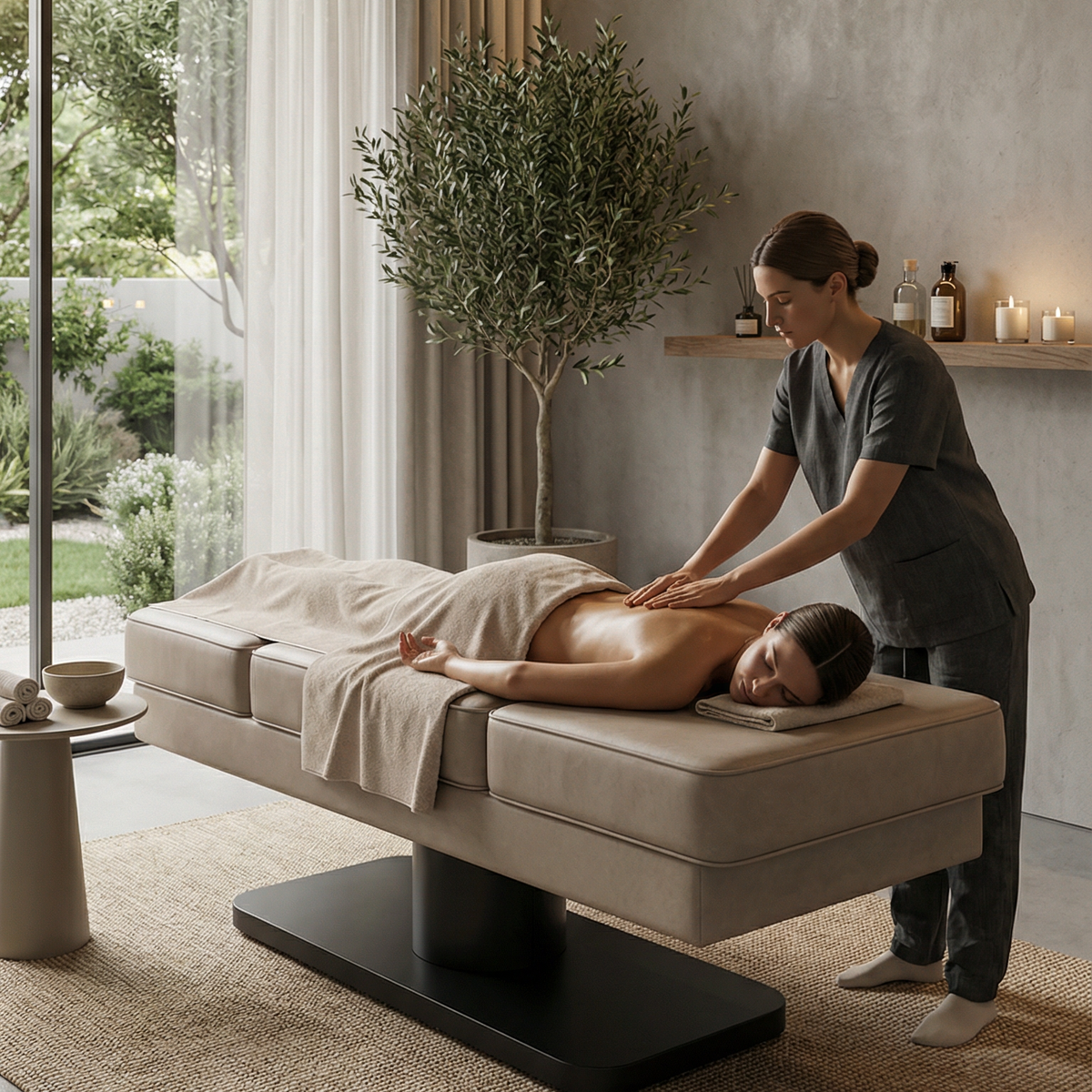
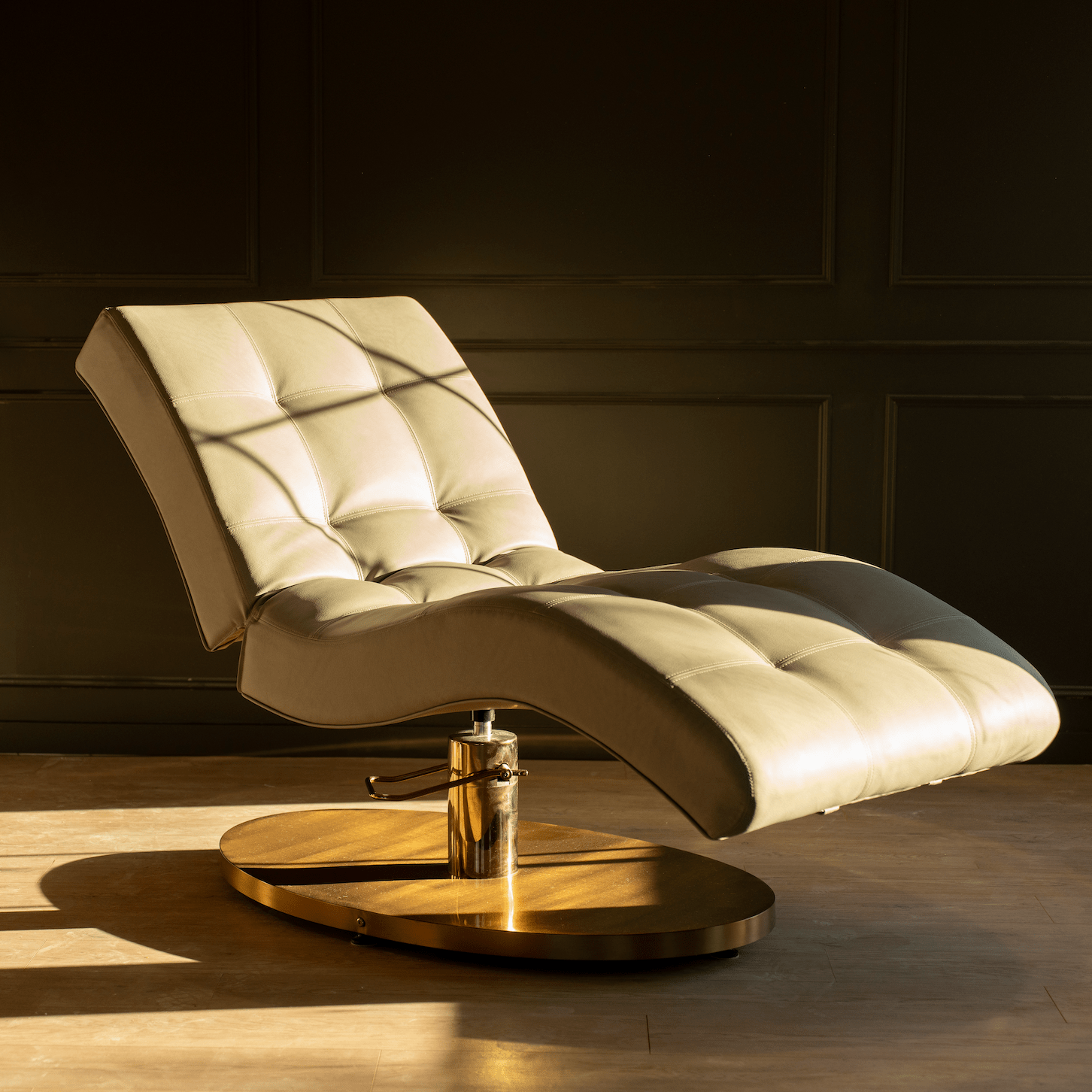
The Oxford is the only electric spa bed on the market with zero visible hardware. No exposed metal arms. No visible hinges. No mechanical components visible from any angle. Just clean, full upholstery from every side. In a room where visual impression matters — and it matters more than most practitioners account for — this is a real differentiator.
It also has a face opening. This is the specific feature that makes the Oxford the right choice for massage practitioners who do standard prone work. No other Plush + Oak bed has this. If face-down positioning is a regular part of your services, the Oxford is the model.
Three independent motors control the base height, backrest, and knee raise separately. The backrest raises to 75 degrees — suitable for partially upright positioning at the end of a session or for consultations. The knee raise provides anti-gravity positioning for lower back support. The bed goes completely flat for full-body work. These three axes of movement give genuinely comprehensive positioning options without the complexity of multiple accessories.
The Oxford PMU is a variant worth knowing: it features a tapered headrest designed for practitioners who need elbow drop positioning during precision head work. For massage therapists whose practice includes facial massage, scalp work, or any technique requiring access from directly above the client's head, this variant provides additional clearance that the standard Oxford does not.
Your Clients Feel The Difference
The experience of lying on an Oxford is noticeably different from a portable table — and not just marginally. Clients who have only experienced standard massage tables describe the Oxford as feeling like furniture in the best possible sense: substantial, supported, comfortable in a way that does not require accommodation.
A client who is fully comfortable for a 90-minute session does not brace or shift. They relax in a way that makes the work easier and the outcome better. That is not a small thing for a manual therapy practice.
When a client is slightly uncomfortable — either from inadequate padding or from a surface that does not respond to their weight correctly — they hold tension without realizing it. They brace against the discomfort. That muscle tension works against what you are trying to accomplish. A bed that suspends the client rather than compressing them allows a deeper and faster onset of relaxation. Sessions produce better outcomes. Clients feel the difference in their body after treatment and attribute it — correctly — to the quality of the work and the environment.
The full upholstery also removes the visual and sensory friction of a portable setup. There are no bolster adjustments, no face cradle to replace, no hardware visible during the treatment. The experience is continuous and professional from the moment the client lies down.
Choosing The Right Oxford For Your Practice
The Oxford Full is the most versatile configuration — three-motor positioning, full face opening, completely clean upholstery, and the tensile suspension system. This is the right choice for most massage practitioners running a permanent single-room practice.
If your practice also includes bodywork or wellness services that require partial positioning — elevation for lymphatic work, gentle incline for certain clients, or reclining for consultations — the Oxford's three independent motors handle all of this without additional equipment. You are not adding a wedge or bolster; you are pressing a button.
Color choice matters more than practitioners typically expect. Because the Oxford is made to order, the color you choose becomes part of your room's identity. A bed in deep charcoal reads as sophisticated and clinical. A bed in warm ivory reads as spa-like and restorative. The right color is the one that matches the experience you are creating — not the one that happened to be available.
Massage Bed Dimensions: What Size Do You Actually Need?
One of the most common questions practitioners ask before buying: what dimensions should my massage bed be?
A standard portable massage table is approximately 28 inches wide and 73 inches long. That width was designed for portability — narrow enough to fold and fit through doorways. It was not designed for client comfort during a 90-minute session. Many larger clients feel the edges. Many practitioners wish they had more surface to work with.
The Oxford is wider and longer than a standard table. The additional surface width means clients of all sizes feel fully supported — no arms hanging off the edge, no feeling of precariousness. For a practitioner, that wider surface also means less concern about client positioning and more focus on the work.
Room size matters for the decision. A massage room should be at minimum 10 feet by 10 feet to accommodate a permanent bed, allow full practitioner movement around all sides, and include space for a stool, side table, and storage. If your room is smaller than that, measure before you order — you need at least 30 inches of clearance on each side of the bed for comfortable working movement.
Height is the other dimension that matters more than most practitioners realize. If your bed is too low, you compensate with your back. Too high, you compensate with your shoulders. The Oxford's electric height adjustment solves this — you set the exact height that matches your body mechanics, and you can adjust between clients if needed. For practitioners who share a room, this matters. One button press. No compromise.
Ceiling height is worth checking if you plan to use the backrest at full elevation. The Oxford raises to 75 degrees — confirm that your room's ceiling accommodates the client in a semi-upright position without feeling cramped.
The Business Case
Over 87% of Plush + Oak customers said their upgrade helped attract more clients. 93% saw their revenue increase. 94% reported better client retention.
A practice environment that communicates permanence, quality, and investment matches the prices that reflect those things. A portable table in a permanent room works against the pricing argument. The Oxford works for it.
The math is direct: if a quality bed allows you to charge $20 more per session and increase your rebooking rate by even 15%, the investment returns itself within months. The bed is not a cost. It is a revenue driver with a one-time price.
Visit plushandoak.com to configure the Oxford that fits your practice — and to build the massage room that earns what it deserves.
Ready to upgrade your massage practice furniture?
Explore the Oxford collection → | Massage room furniture →